Why Your Meta Engagement Campaigns Are Wasting Money (And How to Fix It)
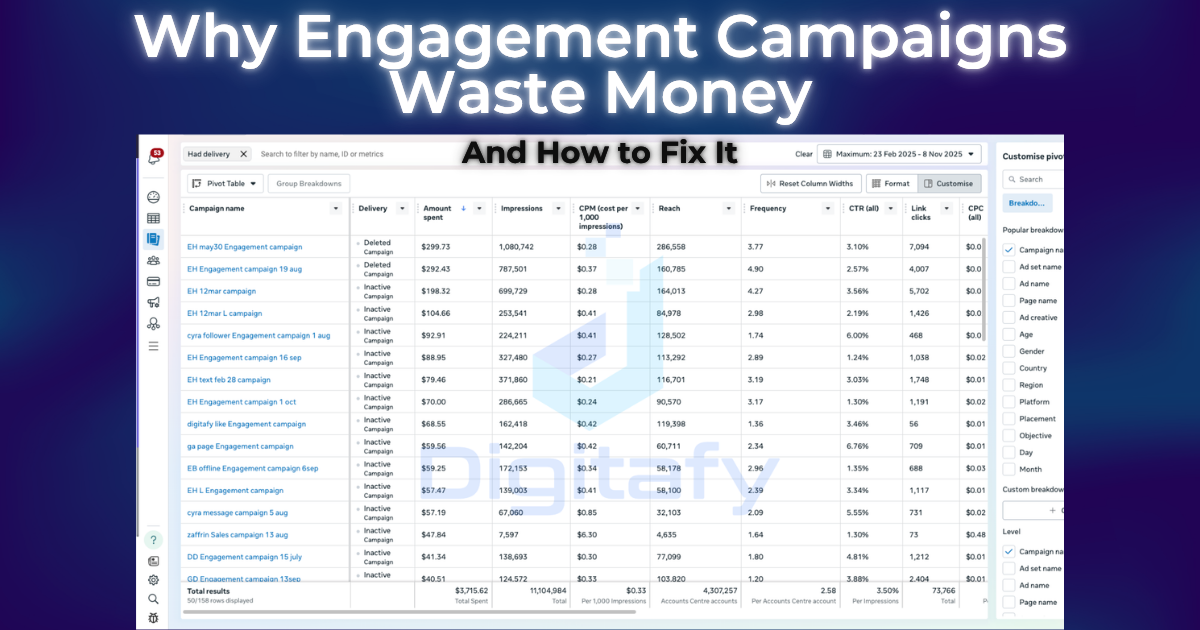
Engagement campaigns are one of the most popular campaign types among Bangladeshi businesses running Meta ads. They're also one of the most misused. We've managed hundreds of engagement campaigns across multiple ad accounts and the pattern is almost always the same. Brands run engagement campaigns, get lots of likes and reactions, feel good about the numbers, and then wonder why sales aren't improving.
Here's the truth about engagement campaigns and how to use them in a way that actually moves your business forward.
What Engagement Campaigns Actually Do
When you run a Meta engagement campaign, you're telling Meta's algorithm to find people who are likely to like, comment, share, or react to your content. That's it. Meta optimizes specifically for that action.
The problem is that people who like posts are not necessarily people who buy things. Meta's algorithm is extremely good at finding people who engage with content. It's less focused on whether those people will ever spend money.
This is why you can run an engagement campaign, get thousands of reactions, and see almost no increase in sales or messages.
When Engagement Campaigns Make Sense
This doesn't mean engagement campaigns are useless. They serve specific purposes when used correctly.
Building social proof on new ads. When you launch a new ad creative, having some engagement on it before you scale makes it appear more credible to cold audiences. People are more likely to click on an ad that already has hundreds of likes than one with zero. Growing page followers who match your target audience. If you're building a long-term brand presence and want to grow a genuine following of people interested in your product category, a well-targeted engagement campaign can do this efficiently. Warming up audiences for retargeting. People who engage with your content become a retargeting audience. Running engagement campaigns at low cost to build this audience pool can then feed higher-intent retargeting campaigns. Video view campaigns as top-of-funnel. A specific type of engagement campaign optimizing for video views can build a large audience of people who watched your content. These are valuable audiences for retargeting with purchase or messaging campaigns.What the Data Shows
Across multiple ad accounts we manage, engagement campaigns consistently deliver high volume at low cost. CPMs for engagement campaigns often range from $0.21 to $0.85 in the Bangladeshi market. Some campaigns have achieved CPMs as low as $0.16 to $0.28 meaning you can reach enormous audiences very cheaply.
One engagement campaign we ran for a fashion brand reached 286,558 people with a 3.77 frequency at a CPM of $0.28, spending less than $300. That's a lot of brand exposure for a small budget.
Another campaign reached over 400,000 unique accounts at a $0.37 CPM. These numbers show that engagement campaigns can deliver reach and frequency at a cost that traditional media cannot compete with.
The key is understanding that these metrics represent awareness and familiarity, not direct purchase intent.
The Right Way to Use Engagement Campaigns in Your Strategy
Think of your Meta advertising as a funnel with multiple stages.
Top of funnel: Engagement and video view campaigns at low CPMs build awareness and create retargeting audiences. Keep budgets modest here relative to your total spend. Middle of funnel: Retargeting campaigns reach people who engaged with your content or visited your website. These audiences are warmer and convert at lower costs. Bottom of funnel: Purchase, messaging, or lead generation campaigns with direct response objectives convert people who are ready to take action.The mistake most brands make is spending too much at the top of the funnel on engagement without investing enough at the bottom where actual conversions happen.
A reasonable budget allocation might be 20 percent on awareness and engagement, 30 percent on retargeting, and 50 percent on direct response conversion campaigns.
Common Engagement Campaign Mistakes
Running engagement campaigns as the primary or only campaign type. If engagement campaigns are 80 percent of your ad spend, you're building awareness but not converting it into sales. Not using engagement audiences for retargeting. If you're running engagement campaigns but not building retargeting audiences from them, you're leaving the most valuable part of the campaign unused. Optimizing for post engagement when you want page likes. These are different objectives and Meta will optimize differently for each. Know what specific action you want and set the campaign accordingly. Using the same creative for engagement and conversion campaigns. Engagement creative should be entertaining and shareable. Conversion creative should be clear about the product and have a direct call to action. These are different goals and often require different approaches.What a Healthy Meta Account Looks Like
A well-structured Meta ads account for a product-based business in Bangladesh typically has a mix of campaign types working together.
Engagement and video view campaigns at the top build awareness and feed retargeting pools. Messaging campaigns convert warm audiences into sales conversations. Website purchase campaigns drive direct online sales for brands with e-commerce capability. Retargeting campaigns close the loop on people who showed interest but didn't buy.
When these work together, your overall cost per acquisition drops significantly compared to running any single campaign type alone.
Final Thoughts
Engagement campaigns are a tool, not a strategy. Used correctly as part of a complete funnel, they can meaningfully lower your overall advertising costs and improve long-term brand performance.
Used in isolation as a substitute for proper conversion campaigns, they generate vanity metrics without driving real business results.
If you're unsure whether your current campaign mix is structured correctly for your goals, we're happy to audit your account. Reach out to Digitafy at digitafy.com.