How We Managed Meta Ads for Multiple Brands Simultaneously: Lessons From a $23,952 Multi-Brand Account
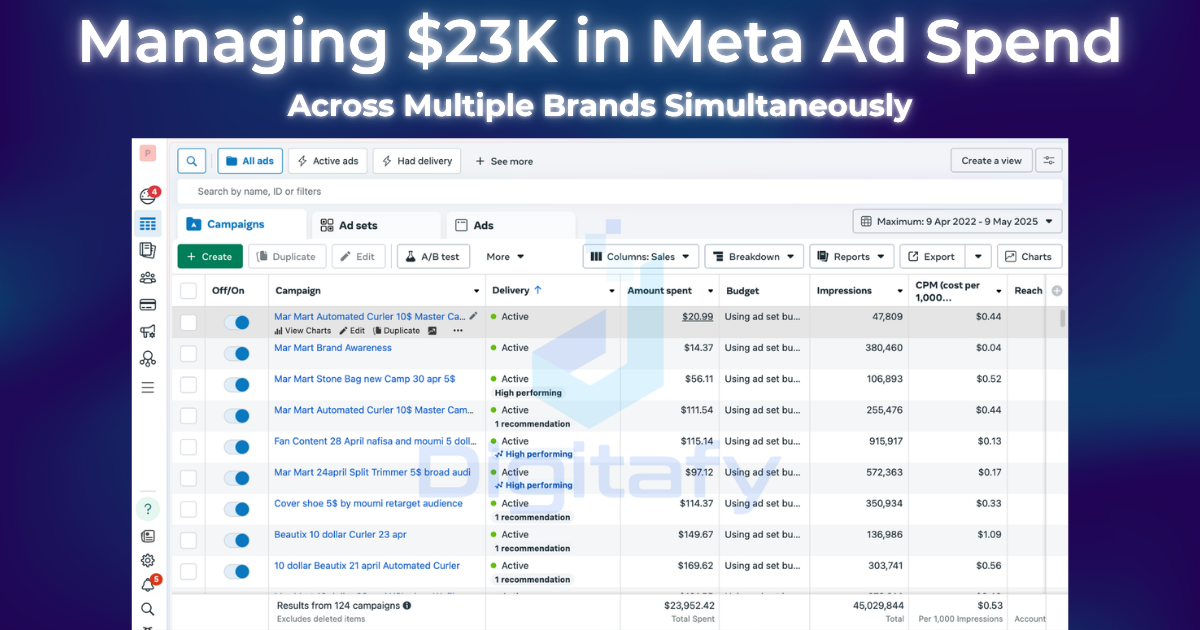
Running Meta ads for a single brand is one thing. Managing campaigns across multiple brands simultaneously, each with their own products, audiences, budgets, and goals, is an entirely different challenge. It requires systems, structure, and a fundamentally different way of thinking about campaign management.
This is what we learned from managing a multi-brand Meta ads operation that generated 45,029,844 total impressions across 124 campaigns with $23,952 in total spend.
The Scale of the Operation
124 campaigns running simultaneously. $23,952.42 total spend in the tracked period. 45,029,844 total impressions. 5,684,597 total reach. Average CPM of $0.53 across all brands and campaigns.
This included multiple fashion brands covering different product categories including bags, shoes, hair care tools, and fashion accessories. Each brand had its own identity, target audience, and campaign strategy but they were all managed within a coordinated framework.
Why Multi-Brand Management Is Complex
When you're managing ads for multiple brands, several challenges emerge that don't exist with a single brand.
Audience overlap. If two brands in the same account are targeting similar audiences, they can end up competing against each other in Meta's auction. This drives up costs for both. Managing this requires careful audience segmentation across brands. Budget allocation decisions. With limited total budget, decisions about how much to allocate to each brand require constant analysis. A brand that is performing well deserves more budget. One that is struggling needs a strategy adjustment, not necessarily more money. Creative management at scale. 124 campaigns means a very large number of individual ad creatives running simultaneously. Keeping track of what is performing, what needs refreshing, and what should be paused requires systematic organization. Reporting across brands. Each brand's stakeholders want to understand their own results. Producing clear, accurate reports that separate performance by brand while also giving a view of overall account health requires proper reporting infrastructure.The Account Structure That Made It Work
The key to managing this scale efficiently was a clear hierarchical account structure.
Each brand had its own campaign naming convention that made it immediately clear which brand a campaign belonged to, what its objective was, and when it was created. This sounds simple but it becomes essential when you're managing over 100 campaigns.
Campaigns were organized by objective type. Awareness and engagement campaigns at the top of the funnel. Messaging and conversion campaigns at the bottom. Retargeting campaigns in the middle. This structure made it easy to see at a glance whether each brand had appropriate coverage across the funnel.
Regular performance reviews compared brands against each other and against their own historical performance. This highlighted both opportunities and problems quickly.
Managing CPM Across Multiple Brands
One of the most interesting findings from managing this account was the significant variation in CPM across different brands and campaign types.
Some campaigns achieved CPMs as low as $0.13, reaching enormous audiences very cheaply. Others ran at $1.09 or higher for more competitive audiences or specific objectives.
The average CPM of $0.53 across the entire account represents healthy efficiency for a mixed portfolio of campaign types. Awareness campaigns pulled the average down. Conversion campaigns pushed it up. The balance between these determines overall account efficiency.
High performing labels appeared consistently on the best-performing campaigns, which Meta's own system recognized as delivering above-average results. These campaigns received priority budget allocation.
The Importance of Creative Diversity
Across 124 campaigns serving multiple brands, creative diversity was essential. Each brand needed its own visual identity and messaging style. A campaign for a fashion bag brand looks and sounds completely different from a campaign for a hair curler brand even if both are targeting similar demographics.
We maintained separate creative briefs for each brand and ensured that ads running simultaneously for different brands were visually distinct enough that audiences wouldn't confuse them.
Regular creative refreshes were scheduled proactively rather than reactively. Waiting for performance to drop before refreshing creatives is a reactive approach that costs money. Planning creative rotations in advance keeps performance more consistent.
What High Performing Campaigns Had in Common
Across all the brands in this account, the campaigns tagged as high performing shared several characteristics.
They had clear, product-focused visuals that immediately communicated what was being sold. They had specific price points mentioned in the ad copy or creative. They targeted relatively broad audiences that gave Meta's algorithm enough room to optimize. And they had been running long enough for the algorithm to accumulate meaningful data.
Interestingly, some of the highest-performing campaigns in terms of efficiency were not the ones with the highest budgets. Smaller focused campaigns with strong creatives often outperformed larger campaigns that had been running too long without creative refresh.
Lessons for Businesses Running Multiple Brands
If you're managing Meta ads for more than one brand, either as an agency or as a business owner with multiple product lines, these principles apply directly.
Keep your account structure clean and consistent. Name campaigns clearly. Organize by brand and objective. Make it easy to find and analyze any campaign quickly.
Watch for audience overlap between brands. Use audience exclusions where necessary to prevent your brands from competing against each other.
Allocate budget dynamically based on performance rather than splitting evenly. The brand or campaign that is working best deserves more resources.
Build separate creative pipelines for each brand. Don't try to repurpose the same creative across very different brands or product categories.
Final Thoughts
Managing Meta ads at this scale requires moving beyond intuition and into systematic, data-driven decision making. The brands that perform best in a multi-brand account are the ones with the clearest strategies, the strongest creatives, and the most consistent optimization process.
At Digitafy, multi-brand Meta ads management is something we do every day. If you're looking for an agency that can handle the complexity of managing multiple campaigns or multiple brands efficiently, reach out at digitafy.com.