How to Scale a Fashion E-commerce Brand to $21,000 Monthly Ad Spend on Meta
Scaling a Meta ads account is one of the most misunderstood parts of digital advertising. Most people think scaling means increasing the budget on a winning campaign. Sometimes that works. But at a certain point, simply adding budget causes costs to rise, performance to drop, and the whole account to become unstable.
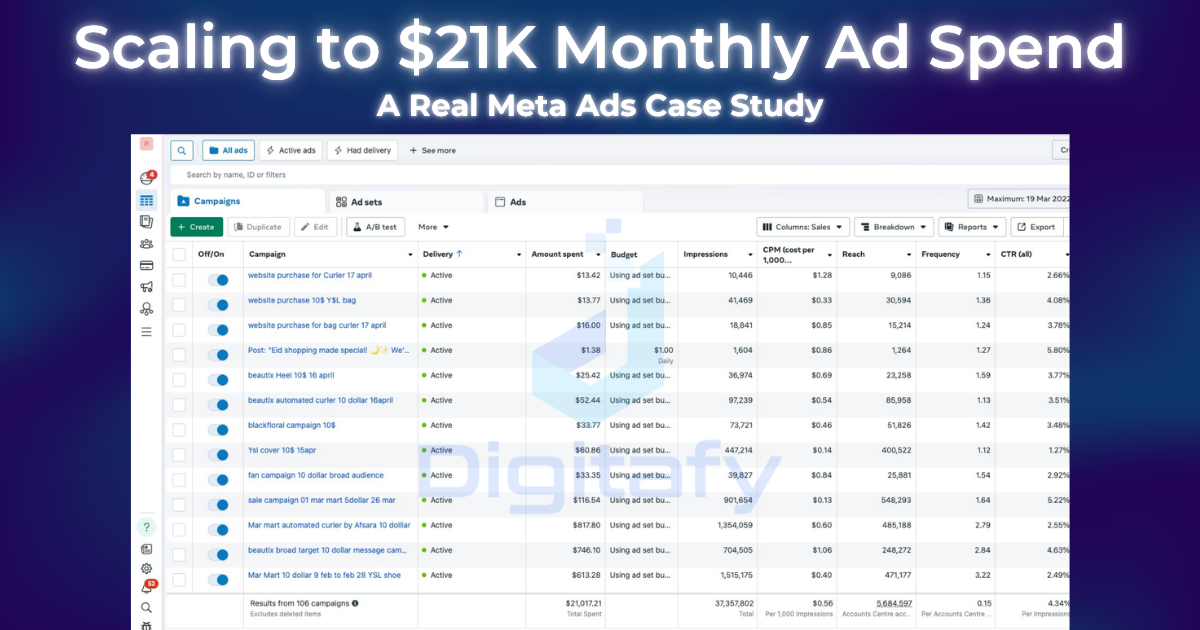
This is how we helped scale a fashion e-commerce brand to $21,017 in monthly Meta ad spend while maintaining a remarkably efficient $0.56 average CPM across 37.3 million impressions.
The Scale of This Account
106 active campaigns. $21,017.21 total spend in the tracked period. 37,357,802 total impressions. 5,684,597 total reach. Average CPM of $0.56.
These are not small numbers. This is a serious e-commerce operation running at scale across multiple product lines including bags, shoes, curlers, and fashion accessories targeting both Bangladeshi and international audiences.
The Core Scaling Philosophy
The biggest mistake brands make when scaling is trying to scale everything at once. They take a winning campaign, double the budget, and wonder why performance suddenly drops.
The right approach to scaling Meta ads involves three principles.
Horizontal scaling over vertical scaling. Instead of doubling the budget on one campaign, we launch new campaigns targeting new audiences, new creatives, or new products. This keeps each individual campaign within its optimal budget range while growing total spend. Keeping winning campaigns stable. When a campaign is performing well, we resist the urge to edit it frequently. Instead we duplicate it, test variations in new campaigns, and let the original keep running untouched. Continuous creative refresh. At scale, ad fatigue becomes a real problem. Audiences get tired of seeing the same ads. We maintain a constant pipeline of new creatives so there's always fresh content to rotate in when performance starts to dip.How the Account Structure Was Built
At this scale, having a clear account structure is essential. The account was organized into distinct campaign categories.
Website purchase campaigns targeted people most likely to buy directly from the website. These ran with sales objectives and pixel-based optimization.
Messaging campaigns targeted people likely to start a conversation on WhatsApp or Messenger. For the Bangladeshi market specifically, a large portion of sales happen through direct conversation rather than website checkout.
Retargeting campaigns targeted people who had visited the website, viewed products, or engaged with previous ads. These typically deliver the highest ROAS because you're reaching warm audiences who already know the brand.
Brand awareness campaigns at lower budgets kept the brand visible to broad audiences and fed the top of the funnel.
Managing CPM at Scale
One of the most impressive things about this account was maintaining a $0.56 average CPM while spending $21,000. This is a sign of healthy campaign structure and strong creative performance.
CPM rises when your ads are not engaging enough for Meta's algorithm to deliver them cheaply, or when you're competing too aggressively for a narrow audience. At scale, managing CPM requires constant creative testing and broad enough audience targeting to give the algorithm room to find the cheapest delivery.
The campaigns with the lowest CPMs in this account were the ones with the broadest targeting and the most engaging creatives. Some campaigns achieved CPMs as low as $0.13, meaning the brand was reaching 1000 people for just 13 cents.
The Role of Automated and Manual Campaigns
At this scale, a mix of automated and manual campaign approaches worked best.
Automated campaigns using Meta's Advantage+ shopping features handled a portion of the spend and consistently found new buyers efficiently. Manual campaigns gave more control over specific audiences and creatives for strategic product pushes.
High performing tags appeared on multiple campaigns indicating Meta's own system recognized these as delivering above-average results. These were prioritized for budget allocation.
Key Lessons From Scaling to This Level
Diversification of ad spend across many campaigns protects against the risk of any single campaign underperforming. When you have 106 campaigns running, one or two bad performers don't significantly impact overall results.
Creative volume matters enormously at scale. A brand spending $21,000 a month needs dozens of ad creatives cycling through constantly. Brands that try to scale with only a handful of creatives hit a ceiling quickly.
Data accumulation compounds over time. An account with years of pixel data, customer lists, and campaign history performs better than a new account at the same spend level. The historical data gives Meta more signals to optimize from.
What This Means for Your Brand
If you're currently spending between $1,000 and $5,000 per month on Meta ads and want to scale further, the principles that drove this account's growth apply directly.
Start by building a diversified campaign structure rather than concentrating everything into one or two campaigns. Invest in creative production consistently. And focus on maintaining healthy CPMs rather than just chasing results at any cost.
At Digitafy, scaling Meta ad accounts sustainably is one of our core strengths. If you want to discuss what a scaling strategy looks like for your brand, get in touch at digitafy.com.